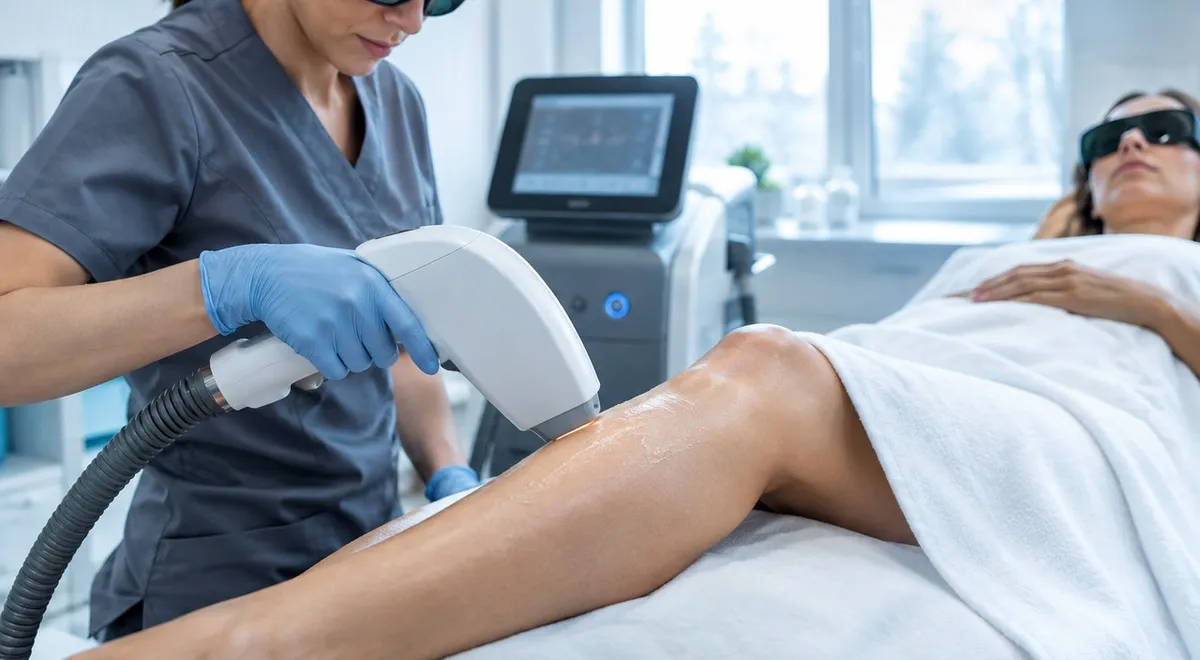
Technician in protective eyewear performing laser hair removal on a client’s lower leg
Reviewed by Dr. Narbeh Tovmassian, MD, FACPWritten by Ani Mardirosian

Laser Hair Removal in Los Angeles: Why Winter Works Best, Session Timeline & Skin Types Covered

If you've been putting off laser hair removal, winter is the right time to start. Tanned skin raises your risk of side effects, so the months when you're least exposed to the sun are when treatment is safest and most effective. Depending on the body area and spacing, many patients who start now can finish a six-session series by late spring, while areas that need more sessions can run into summer.

At Elevate Aesthetics LA, laser hair removal is available for a wide range of body areas and skin types, with settings adjusted to match your Fitzpatrick skin tone and hair texture.
Why Winter Timing Makes a Practical Difference

Laser hair removal works by targeting melanin in the hair follicle. When surrounding skin carries a tan, the laser has more difficulty distinguishing between hair pigment and skin pigment, which increases the risk of burns, blistering, and post-inflammatory hyperpigmentation.

Providers typically advise avoiding sun exposure for at least two weeks before and after each session, and your provider will give you timing that fits your skin and device. Starting in fall or early winter makes that guideline easy to follow naturally, without having to schedule around beach trips or outdoor events.

There is also a practical timing advantage. Most patients need 6 to 8 sessions spaced 4 to 6 weeks apart. Starting in November, six sessions spaced 4 to 6 weeks apart would finish between late March and late May, while eight sessions at the longer spacing can run into late August. Your provider can build a schedule for your body area.

How the Laser Targets Hair Follicles

The laser emits a focused wavelength of light that is selectively absorbed by melanin in the hair shaft and follicle. The heat generated damages the follicle to a degree that inhibits future growth. Because hair cycles through active growth (anagen), transitional (catagen), and resting (telogen) phases independently from follicle to follicle, the laser is most effective when it catches hair in the anagen phase. That is the primary reason multiple sessions are required.

Different laser types, which you can explore on our laser technology page, are used depending on skin tone and hair characteristics:

Diode lasers cover a wide range of skin types and deliver good penetration depth, making them effective on coarser, denser hair across most body areas.

Nd:YAG lasers use a longer wavelength that is absorbed less by surface melanin, so they are commonly selected for Fitzpatrick Types IV through VI (olive to deep skin tones). Your provider chooses the device after assessing your skin.

Alexandrite lasers are highly efficient on lighter skin tones with darker hair because melanin absorbs the 755nm wavelength well, allowing treatment at lower energy levels.

IPL (intense pulsed light) is frequently marketed alongside laser hair removal but is not a laser. It emits a broad spectrum of light rather than a single targeted wavelength, making it less precise. Clinical lasers remain the standard for long-term hair reduction.

Session Timeline Broken Down

Sessions 1 and 2: Treated hairs shed within 1 to 3 weeks after each session. Regrowth returns, but this is expected. Early sessions are about disrupting the follicle cycle across different growth phases simultaneously.

Sessions 3 and 4: By this point most patients notice that regrowth is finer, slower, and noticeably thinner. High-volume areas like underarms often look significantly cleaner between sessions without shaving as frequently.

Sessions 5 through 8: Remaining active hairs tend to be lighter and finer, which makes them harder to target. These finishing sessions address what early treatments missed and lock in long-term reduction.

The FDA allows laser hair removal devices to claim permanent hair reduction, defined in clearance summaries as the long-term, stable reduction in the number of hairs regrowing, measured at 6, 9 and 12 months after the final treatment. It does not mean every hair is removed. For most patients that means noticeably less hair that grows back finer and slower, and our complete laser hair removal guide explains what maintenance may look like.

Skin Types and What the Fitzpatrick Scale Means for Treatment

The Fitzpatrick skin phototype scale classifies skin tones from Type I (very fair, always burns) to Type VI (deeply pigmented, never burns). Providers use this classification to select the right laser and settings before treating.

Fitzpatrick Types I through III respond well to alexandrite and diode lasers because there is high contrast between skin tone and hair pigment, allowing the laser to zero in on the follicle precisely.

Fitzpatrick Types IV through VI are commonly treated with longer-wavelength devices like the Nd:YAG to minimize surface absorption. With the right device and settings chosen by an experienced provider, laser hair removal can be used across Fitzpatrick types, although results and risks vary by individual.

A consultation before starting is important. A qualified provider will assess your skin tone, hair color, and treatment area, then set the appropriate fluence and pulse duration for your first session.

Which Body Areas Are Commonly Treated

Nearly any body area with unwanted hair can be treated. Common areas include:

  • Legs, partial or full
  • Underarms
  • Bikini line and Brazilian
  • Back and shoulders
  • Chest and abdomen
  • Upper lip, chin, and jawline
  • Sideburns
  • Arms

The number of sessions varies by area. Underarms and bikini line treatments respond fastest, with significant reduction often visible after 4 to 6 sessions. Legs and back, which cover more surface area and have follicles at different cycle stages, typically need the full 6 to 8 sessions or more to reach maximum reduction.

Pre- and Post-Treatment Basics

Our laser hair removal pre and post care guide covers everything in detail. Before each session, shave the treatment area 24 hours in advance. Do not wax, thread, or use depilatory creams in the weeks before a session, as those methods remove the hair shaft the laser needs to target. Avoid sun exposure, self-tanner, and prescription retinoids for at least one week before each appointment.

After each session, expect the treated skin to feel warm and look slightly red around the follicles for 24 to 48 hours. Apply a gentle moisturizer and SPF daily. Avoid hot showers, saunas, and vigorous exercise for the first day. Keep the area out of direct sun until redness fully resolves.

Ask about package options during your consultation. Buying a full series upfront is consistently more cost-effective than paying per session.

Who Should Wait or Check With a Provider First

Laser hair removal is not right for everyone at every moment. Tell your provider before treatment if you are pregnant, have an active skin infection, open wound or cold sore in the treatment area, have a recent tan or self-tanner, take medication that makes skin sensitive to light (including isotretinoin), or have a history of keloid scarring or pigment changes. Your provider will decide whether to proceed, wait or adjust settings.

Frequently Asked Questions

Most patients need 6 to 8 sessions spaced 4 to 6 weeks apart. The exact number depends on body area, hair color and texture, and Fitzpatrick skin type. Hormonal areas like the face, bikini line, and abdomen may need additional sessions due to ongoing hormonal stimulation of follicle activity.

Yes, when the right device and settings are used. Longer-wavelength lasers such as Nd:YAG are commonly selected for Fitzpatrick Types IV through VI. The key is selecting the correct device for your skin tone, which is why a consultation before starting is essential.

Most patients describe the sensation as a rubber band snap or mild stinging at each pulse. Modern laser devices include integrated cooling systems that significantly reduce discomfort during the session. Topical numbing cream can be applied before treatment in sensitive areas if needed.

It is best to wait until your tan fades before starting a new series. Active tanning, including from self-tanner, increases the risk of burns and pigment changes. If you are already mid-series and you got sun exposure between sessions, tell your provider so they can assess whether to proceed or adjust settings.

After completing a full series, many patients keep long-term hair reduction, although results vary. Hormonal changes from pregnancy, menopause, or medication shifts can stimulate new growth over time. Some patients choose occasional maintenance sessions to keep results stable.

Pricing depends on the body area and on whether you buy single sessions or a package, and packages usually lower the per-session cost. Elevate lists current rates on its pricing page, or you can contact the clinic for a quote for your specific areas.

Ready to start before summer? Book a consultation at Elevate Aesthetics LA and get a custom treatment plan for your skin type and target areas.

Elevate Aesthetics
509 1/2 E. Broadway, Glendale, CA 91205
4.95 stars
Opening Hours
Monday - Thursday10:00 AM - 5:00 PM
Friday10:00 AM - 4:00 PM
Saturday9:00 AM - 2:00 PM
SundayClosed
Newsletter background

Stay In The Loop

Get updates on new treatments, promotions, and clinic news.