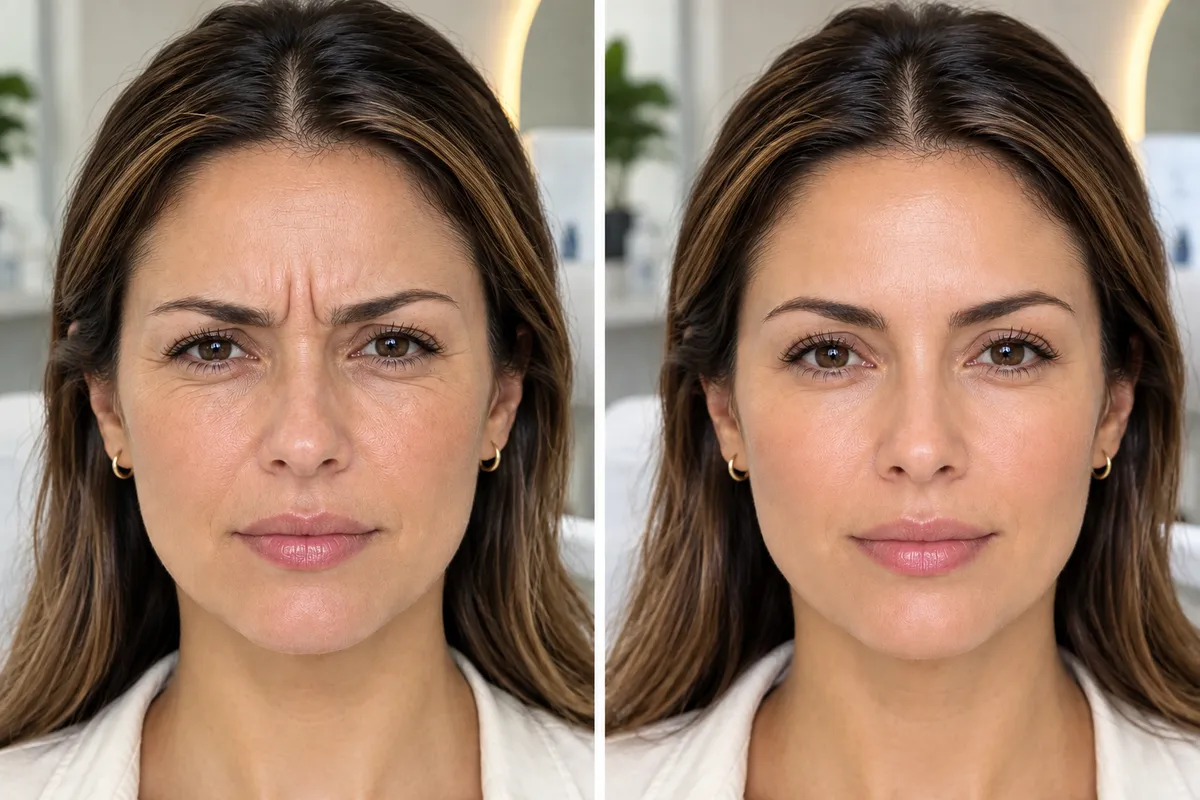
Botox before and after showing smoother forehead and facial lines following treatment
Reviewed by Dr. Narbeh Tovmassian, MD, FACPWritten by Ani Mardirosian

What Botox Actually Does to Your Face: Results, Timeline and Aftercare

Most Botox before and after photos online show the best possible outcomes under the best possible lighting. This article covers what realistic results look like, when you will see them, how long they last, and what the aftercare period actually requires, so you can go into your first or next appointment with accurate expectations.
What Botox Does (and Does Not Do)

Botox is a neuromodulator, not a filler. It works by temporarily blocking the nerve signals that tell specific facial muscles to contract. When those muscles relax, the skin above them smooths out. What it does not do is add volume, lift sagging skin, or address texture issues caused by sun damage or collagen loss.

The areas where Botox delivers the clearest before and after contrast are those where repeated muscle movement has etched lines into the skin: the forehead, the space between the brows (glabella), and the outer corners of the eyes (crow's feet). Lines that are present only when the face is moving (dynamic wrinkles) respond well. Lines that are visible even when the face is completely still (static wrinkles) respond partially or not at all, because the skin has already lost structural support beneath the surface.

This distinction matters for expectations. If your primary concern is deep static lines or volume loss, dermal fillers at Elevate Aesthetics address that differently than Botox does.

Realistic Before and After: What Changes and What Does Not

What you will see:

  • Forehead lines flatten significantly or disappear at rest
  • The "11 lines" between the brows soften or resolve
  • Crow's feet reduce, especially when squinting or smiling
  • A lifted, more open appearance around the brow
  • Reduced visibility of a gummy smile (for lip flip applications)
  • Smoother upper lip border (when used as a lip flip)

What you will not see:

  • Elimination of deep, long-established static lines after one session
  • Volume restoration in sunken or hollow areas
  • Tightening of loose or crepey skin
  • A "frozen" look when dosed conservatively and placed correctly

The frozen appearance that many patients worry about comes from either too many units or poor placement. A skilled injector uses enough product to relax the targeted muscle without eliminating all movement in the area. You should still be able to raise your brows, show surprise, and smile naturally. The face moves; it just does so without pulling the skin into deep folds.

Botox Timeline: Day by Day

Understanding the timeline prevents misplaced concern in the days immediately after your appointment.

Day of treatment: The injection sites may appear slightly red or have small raised bumps at the entry points. These typically resolve within 30 minutes to an hour. You will not see any effect on your wrinkles yet.

Days 1 to 3: No visible change in most patients. Some notice the very beginning of muscle relaxation around day 3, but the treatment has not fully taken effect.

Days 4 to 7: The most noticeable transition period. The targeted muscles begin relaxing more completely. Lines that were present at rest start to soften. Some patients report that this phase feels uneven, with one side appearing to respond slightly faster than the other. This is normal and typically resolves by the end of the week.

Days 7 to 14: The full result becomes visible. This is when your before and after comparison is meaningful. The treatment is considered complete at the two-week mark, which is why reputable providers schedule any touch-up appointments at this point rather than sooner.

Months 1 to 3: Results remain stable. Most patients experience peak results in this window.

Months 3 to 4: For most patients, the neuromodulator begins to wear off. The treated muscles gradually regain their ability to contract, and lines begin reappearing. The rate of breakdown varies by individual metabolism, the area treated, and how much muscular activity that area sees. The forehead and between the brows typically last three to four months; areas with heavy movement like around the mouth may wear off closer to two months.

Our Botox treatments in Glendale follow this same timeline, and we schedule two-week follow-ups for any first-time patients who want to assess their results in person.

How Many Units and Sessions to See Results

First-time Botox patients often see a more dramatic before and after than patients who have had it for years, simply because the contrast is greater. The standard unit ranges by area are:

Treatment AreaTypical Units
Forehead lines10-20 units
Glabella (11 lines)20-25 units
Crow's feet (both sides)12-24 units
Brow lift4-8 units
Lip flip (upper lip)4-6 units
Gummy smile4-8 units

These ranges vary based on the strength of the muscle, the depth of the existing lines, and the level of correction the patient wants. A full face treatment hitting all major areas typically uses 40 to 60 units. A targeted single-area appointment uses far less.

Patients who maintain regular Botox appointments often find that over time they need slightly fewer units to achieve the same result. The muscle atrophies slightly from disuse, and the lines do not deepen as significantly between sessions.

Botox Aftercare: What to Do and What to Avoid

Aftercare in the first 24 hours has the most direct effect on your outcome. The goal is to keep the product where the injector placed it and reduce the risk of bruising.

For the first 4 hours:

  • Remain upright. Do not lie down or bend forward for extended periods.
  • Do not rub, massage, or apply pressure to the treated areas.
  • Skip makeup on the injection sites if possible.
  • Avoid touching your face unnecessarily.

For the first 24 hours:

  • No strenuous exercise. Increased blood flow and heat can accelerate dispersal of the product.
  • No alcohol. It thins the blood and increases bruising risk.
  • No facial treatments: microneedling, chemical peels, laser treatments, or facials.
  • No saunas, steam rooms, or hot tubs.

For the first 2 weeks:

  • Avoid any skin treatment that creates heat or significant pressure on the treated areas.
  • If you notice bruising, arnica gel can help reduce it but does not affect the Botox itself.
  • Do not schedule dental work if it requires sustained pressure or holding your face in an unusual position for long periods.

What you can do normally:

  • Wash your face gently with a mild cleanser after the first few hours.
  • Apply your regular skincare routine from the following day, avoiding heavy rubbing.
  • Return to work and normal daily activities immediately.

When Results Are Not What You Expected

Two situations prompt concern after Botox: too little effect or an uneven result.

Too little effect after two weeks usually means the dosage was conservative for a first session. A touch-up appointment at the two-week mark can add a small number of units to the undertreated area. This is standard practice and preferable to over-treating at the initial appointment.

Uneven results can stem from natural muscle asymmetry (which exists in nearly every face), product dispersal, or placement that did not account for the asymmetry. A skilled injector assesses this at the follow-up and adjusts accordingly.

Brow heaviness or drooping is the most common concern. It occurs when product migrates toward the elevator muscles of the brow. It is temporary, resolving as the Botox wears off, and it is manageable with eye drops in the meantime. This is why aftercare in the first four hours matters.

If you are considering Botox and want to know how it compares to Dysport, another neuromodulator with a slightly faster onset and more diffuse spread, that is worth discussing at your consultation. The active ingredient is the same class of toxin; the formulation differs.

Frequently Asked Questions

The two-week mark is when results are fully settled. Photos taken earlier may show swelling, redness, or partial results that do not reflect the finished outcome. Always compare your before photo to an after photo taken at or after day 14 for an accurate assessment.

Most patients see significant improvement by day 7, but the result is not complete. The muscles are still in the process of relaxing. Some patients see the full effect by day 7; others take the full 14 days. Do not judge the outcome before the two-week mark.

It can. Static photos capture the face at rest, where Botox effects are most visible. In motion, particularly on video or in dynamic expressions, the face continues to move; only the deepest lines are reduced. Some patients find their result looks more dramatic in photos than they perceive it in person, which is a reasonable outcome given that photos are where most social documentation of appearance happens.

Consistent treatment schedules, avoiding high-heat environments frequently, and treating the area before lines deepen significantly all contribute to longer-lasting results over time. Zinc supplementation has been explored in some studies as a factor in neuromodulator longevity, but the evidence is not strong enough to recommend it as a reliable strategy.

The protocol is the same. The difference is that first-time patients often have stronger muscles with no prior neuromodulator history, which can mean slightly longer onset time and a more dramatic change in results. The aftercare rules apply equally regardless of whether it is your first or tenth session.

This is determined at consultation based on the strength of your target muscles, the depth of your existing lines at rest, and how conservative or expressive a result you want. There is no universal answer. Our team at Elevate Aesthetics assesses each patient individually; you can review our services and pricing before your appointment to understand the per-unit structure.

Book Your Consultation at Elevate Aesthetics in Glendale

Realistic Botox before and after results depend on accurate placement, the right number of units, and proper aftercare. If you are considering your first treatment or want a second opinion on your current results, schedule a consultation at Elevate Aesthetics in Glendale. We will assess your anatomy, walk through what to expect at each stage, and build a treatment plan that fits your goals and your face.

View our full injectables services or contact us directly to book.

Elevate Aesthetics
509 1/2 E. Broadway, Glendale, CA 91205
4.95 stars
Opening Hours
Monday - Thursday10:00 AM - 5:00 PM
Friday10:00 AM - 4:00 PM
Saturday9:00 AM - 2:00 PM
SundayClosed
Newsletter background

Stay In The Loop

Get updates on new treatments, promotions, and clinic news.